Family rules are usually the first thing parents reach for when home starts to feel a little chaotic. Someone hit their brother. Someone was on a tablet until 10 p.m. Someone said they brushed their teeth when they didn’t. In turn, we make rules.
Rules matter. Children feel safer when they know what’s expected of them. But between the two of us, we spent close to seventy years in schools, and we observed something over and over again: rules are the behaviors. Culture is the why.
A rule tells your child what to do. Your family culture tells them why it matters. When children understand the why, the rules become second nature, and the rules follow them whether you’re in the room or not.
Below you’ll find 50 family rules examples organized by topic, house rules by age, five steps for creating your rules together, and a free printable family rules poster you can make your own.
Why family rules work (and why most don’t)
Good family rules give children clear expectations. They know what’s okay, what isn’t, and what happens next. That clarity is a gift. As Steven likes to say, “A healthy culture always starts with clarity.”
So why do so many house rules end up ignored, forgotten, or argued about every single night? In our experience, it usually comes down to three things.
Too many rules. A list of 25 rules on the refrigerator is a list nobody can remember. Who can remember 25 things? Not most adults, and certainly not a six-year-old.
Too vague. “Be good.” “Be respectful.” “Behave.” These sound clear to us, but a child can’t picture them. Two people in the same house can mean very different things by “respect.” A rule works when a child can see exactly what it looks like in action.
Made by parents alone. This one surprises people. Steven learned it in his first year of teaching: “I know I built a culture that was not really what I cared about. It was about compliance and about following rules.” Compliance lasts as long as someone is watching. When children help create the rules, they own them.
The good news? All three are easy to fix. Fewer rules. Clearer words. Everyone at the table.
50 family rules examples
Notice that almost every rule below starts with “We.” That’s on purpose. “We” says this is who our family is, not just what the kids have to do. And yes, parents should follow the rules too! Children are watching how we show up.
You don’t need all 50. Read through the list and circle the ones that fit best for your family.
Safety
Safety rules are the ones that aren’t up for debate. Keep the wording short so even the youngest child can say it back to you.
| # | The rule | Say it like this |
| 1 | No hitting, kicking, or biting | We use gentle hands and feet. |
| 2 | Seat belts on every ride | We buckle up before the car moves. |
| 3 | Stay close in public | We stay where a grown-up can see us. |
| 4 | Ask before leaving | We ask before we go anywhere. |
| 5 | Helmets on bikes and scooters | Helmets on before wheels go round. |
| 6 | Don’t open the door to strangers | A grown-up answers the door. |
| 7 | No running indoors | We walk inside and run outside. |
Respect and kindness
These rules shape how everyone in the house treats each other, especially on the hard days.
| # | The rule | Say it like this |
| 8 | No yelling or mean words | We use kind words, even when we’re upset. |
| 9 | Don’t interrupt | One person talks, everyone listens. |
| 10 | Respect privacy | We knock and wait. |
| 11 | Don’t take other people’s things | We ask before we borrow. |
| 12 | Don’t leave anyone out | Everyone gets a turn to play. |
| 13 | Use good manners | We say please and thank you. |
| 14 | No name-calling | We call people by their names. |
| 15 | Apologize | When we hurt someone, we say sorry and help make it right. |
Honesty
Children tell the truth more often when the truth is safe to tell. These rules make it safe.
| # | The rule | Say it like this |
| 16 | No lying | We tell the truth, even when it’s hard. |
| 17 | Own your mistakes | We own our mistakes. |
| 18 | No sneaking | If we’re not sure, we ask. |
| 19 | Keep your promises | We do what we say we’re going to do. |
| 20 | Don’t hide problems | Telling the truth is always safer here than hiding it. |
| 21 | Tell a grown-up about worries | Surprises are fun. Worries get shared with a grown-up. |
Responsibility and chores
Every member of the family contributes. These rules make that clear without the daily reminders.
| # | The rule | Say it like this |
| 22 | Clean up after yourself | We leave it better than we found it. |
| 23 | Put things away | Everything has a home. |
| 24 | Make your bed | We make our beds in the morning. |
| 25 | Help around the house | Everyone does their part. |
| 26 | Homework before play | Work first, then play. |
| 27 | Take care of belongings | We take care of our things. |
| 28 | Laundry in the hamper | Dirty clothes go in the basket. |
| 29 | Follow through | We finish what we start. |
Screens and devices
Screen rules work best when the whole family follows them, grown-ups included.
| # | The rule | Say it like this |
| 30 | Ask before screen time | We ask before we turn on a screen. |
| 31 | Screens in shared spaces | Screens stay where the family is. |
| 32 | No phones in bedrooms at night | Phones sleep in the kitchen. |
| 33 | Be kind online | We’re as kind online as we are in person. |
| 34 | Report anything upsetting | If something online feels wrong, we tell a grown-up. |
| 35 | Protect personal information | We keep our private information private. |
| 36 | Respect time limits | When the timer rings, the screen goes off. |
Mealtimes
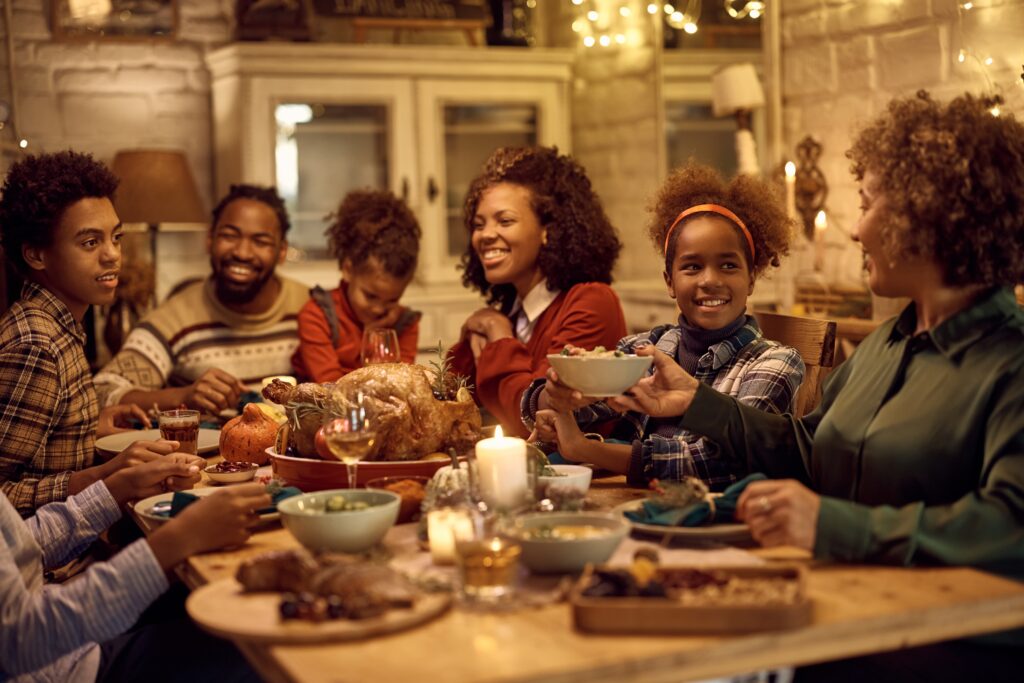
Family meals are one of the best opportunities you have to connect. A few simple rules protect that time.
| # | The rule | Say it like this |
| 37 | Come when called | We come to the table when we’re called. |
| 38 | No devices at the table | Phones and tablets take a break at dinner. |
| 39 | Try new foods | We try one bite. |
| 40 | Talk with each other | Everyone gets a turn to share about their day. |
| 41 | Show appreciation | We thank the person who made the meal. |
| 42 | Stay seated | We stay at the table until we’re excused. |
| 43 | Clear your plate | We carry our own dishes to the sink. |
Bedtime
Bedtime goes more smoothly when the routine is the same every night and everyone knows the steps.
| # | The rule | Say it like this |
| 44 | Consistent bedtime | We start getting ready at the same time every night. |
| 45 | Follow the routine | Bath, teeth, books, bed. |
| 46 | Stay in bed | When the lights go out, we stay in bed. |
| 47 | Keep it quiet | We use whisper voices after bedtime. |
| 48 | Screens off before bed | Screens go to sleep before we do. |
| 49 | End the day connected | We say goodnight and I love you. |
| 50 | Prepare for tomorrow | We get tomorrow ready tonight. |
You may recognize a few of these. “We leave it better than we found it” comes straight from Leave It Better Than You Found It, one of the Fundamentals families select in the Our Family Culture System. “We tell the truth, even when it’s hard” echoes the Fundamental Do the Right Thing. “We do what we say we’re going to do” is Honor Your Word.
That’s no accident. The best family rules are your values, put into words a child can live by.
House rules by age
The right house rules for kids change as your children grow. A three-year-old and a fifteen-year-old need very different things from you.
Toddlers and preschoolers: 3-5 rules, with pictures
Young children can hold on to only a few rules at a time. Choose three to five and keep the words short. “We use gentle hands.” “We walk inside.” “Everything has a home.”
Add a simple picture next to each rule, a drawing of two hands or a toy going into a bin. Little ones can’t read the poster yet, but they can point to it. Then practice, practice, practice. At this age, the rule is learned by doing it with you, again and again.
School-age children: 5-8 rules
This is the age when children start to care deeply about what’s fair. Use that! Invite them to help write the rules and to suggest what should happen when a rule is broken. You’ll be surprised how thoughtful they are.
Five to eight rules is plenty. If your list is growing past that, look for two rules that are really saying the same thing and combine them.
Teens: fewer rules, more agreements
Steven ended his career as a high school teacher still believing that “teenagers are amazing, have great ideas, and deserve to be treated with seriousness and respect.” House rules for teens should reflect that.
Keep a short list of non-negotiables, usually around safety. For everything else, from curfew to phones to the car, move from rules to agreements you work out together. What does your teen think is reasonable? What would help you trust that plan? Teens respond well when they’re treated as contributors to the family’s culture, not just students of it.
We are raising adults, and the teen years are crucial for developing autonomy and agency. Collaborating on agreements with teens is a great way to get to what’s most important to each of you. You might just be surprised by what they have to say.
How to create your family rules together
It’s funny. Almost all parenting advice is about what to do, but not who to be. Family rules can be both, if you build them the right way.
1. Start from your values
Before you write a single rule, get clear on what matters most to your family. When we asked parents in our focus groups to name five important qualities they hoped their children would have, many said “kind… honest…” and then got stuck. And when they could name more, their list rarely matched their partner’s.
That’s normal! Each of you was raised in a different home, with different rules and different ideas about what mattered. Talk about that. Which rules from your own childhood do you want to keep? Which ones do you want to leave behind?
Our guide to family core values is a good place to start. You can also download our Family Fundamentals list. If you’re parenting with a partner, print two copies, circle your favorites separately, then compare. Start with the ones you have in common.
2. Hold a family meeting
Bring everyone to the table, including the children. Steven’s family held a Sunday family huddle every week, and it was a powerful place for building strong family connections. It’s the perfect place to talk about rules. Ask your children: What helps our home feel good? What makes it hard? Write down every idea. Our guide to family meetings walks through how to run one.
3. Phrase rules positively
“No hitting” tells a child what not to do. “We use gentle hands” tells them what to do instead. Positive rules are easier to picture, easier to remember, and easier to say out loud in the middle of a meltdown.
Short phrases also become family shorthand. Nancy describes walking into a messy kitchen and not needing to say anything at all: You look at the kid, the kid looks at you, and they say, ‘I know. Leave it better than you found it. I got it, Mom, I’ll take care of this.’ Once you have the language, the nagging goes away, because it’s just who your family is and what you all do. And it always helps to acknowledge your kids when they are living out the Fundamental.
4. Agree on consequences ahead of time
Decide together, while everyone is calm, what happens when a rule is broken. Keep consequences connected to the rule. If screens stay on past the timer, screen time is shorter tomorrow. If a toy gets thrown, the toy takes a break. When children help set the consequence, it feels fair, and you don’t have to invent one in the middle of an argument.
5. Post them and review monthly
Put your rules where everyone will see them every day. The refrigerator works great. But posting them is only the beginning. Steven has watched schools come out of a planning session with five core values and “put them on the wall, and never talk about them again. Total failure, always.”
Culture is built in slow drips. Look at your rules together once a month. What’s working? What needs to change? What has become second nature, and can come off the list?
Free printable family rules poster
Ready to make your rules official? Our free family rules poster is an editable template you can fill in with your own family’s rules, in your own words. Print it, sign it together, and hang it where everyone will see it.
This is what we call family culture
Family rules shape what your children do. Family culture shapes who they become. When your rules grow out of your values, and your family practices those values together, you’re doing more than managing behavior. You’re building a family culture. Learn what family culture is and why it matters.
The Our Family Culture System makes this simple. Your family selects the Fundamentals that matter most to you, usually between 13 and 20. Then you practice one Fundamental on purpose each week, with short activities and conversations built right into your week. When you’ve worked through your list, the cycle repeats with different content, for life.
This isn’t one more thing. This is the foundation all the other things rest on.
Wondering how to help your children really hear you? Read our guide on how to get kids to listen.
How you behave is who you are. Start building your family culture today.